 Go Back to AI Builds
AskSphere
A chat interface built for one thing: investment research that actually knows our portfolio.
Design and a working build for internal research. Done in Cursor.
The problem
The answers sat in our portfolio systems. ChatGPT could not see them.
General purpose LLMs like Claude, ChatGPT, Gemini and others are trained on the open internet. None of them can see the systems that hold our actual portfolio data. Every week the same questions got asked again, in different words, by different people.
The data lives outside public reach
Our portfolio truth sits in internal systems of record (SoRs), not on the public internet. A general purpose LLM has nothing to reason with.
Every question started from zero
No history and no institutional memory. The same question got re-asked in different words every week, by different people.
Access is not one size fits all
A public chatbot has no concept of who should see what across an organization. Permissions needed to be built in, not bolted on.
No SoR access
The number lives in our systems. ChatGPT never sees it.
Same question, every week
No shared history. Each person starts over.
Two kinds of questions
A count from a table. A clause from a PDF. One box cannot tell them apart.
No permissions
Who should see whose queries is not a ChatGPT setting.
NAV recon by hand
Two sources, two numbers. Someone has to notice the gap.
No source on the number
If the answer cannot point at a file, it cannot be trusted.
Origin
Where this came from
AskSphere began as a small search feature inside Prism for LP. Analysts already had the questions. Prism could not hold the research. This is the expansion: a standalone interface connected to the systems that hold the portfolio.
Hard rules
Built into the product, not painted on later
These rules decide what AskSphere can see, who can see it and how an answer is formed. They are not UI decoration.
Answers come from SoRs
Both modes connect to backend systems of record. The model does not invent from the open internet.
Two paths, one box
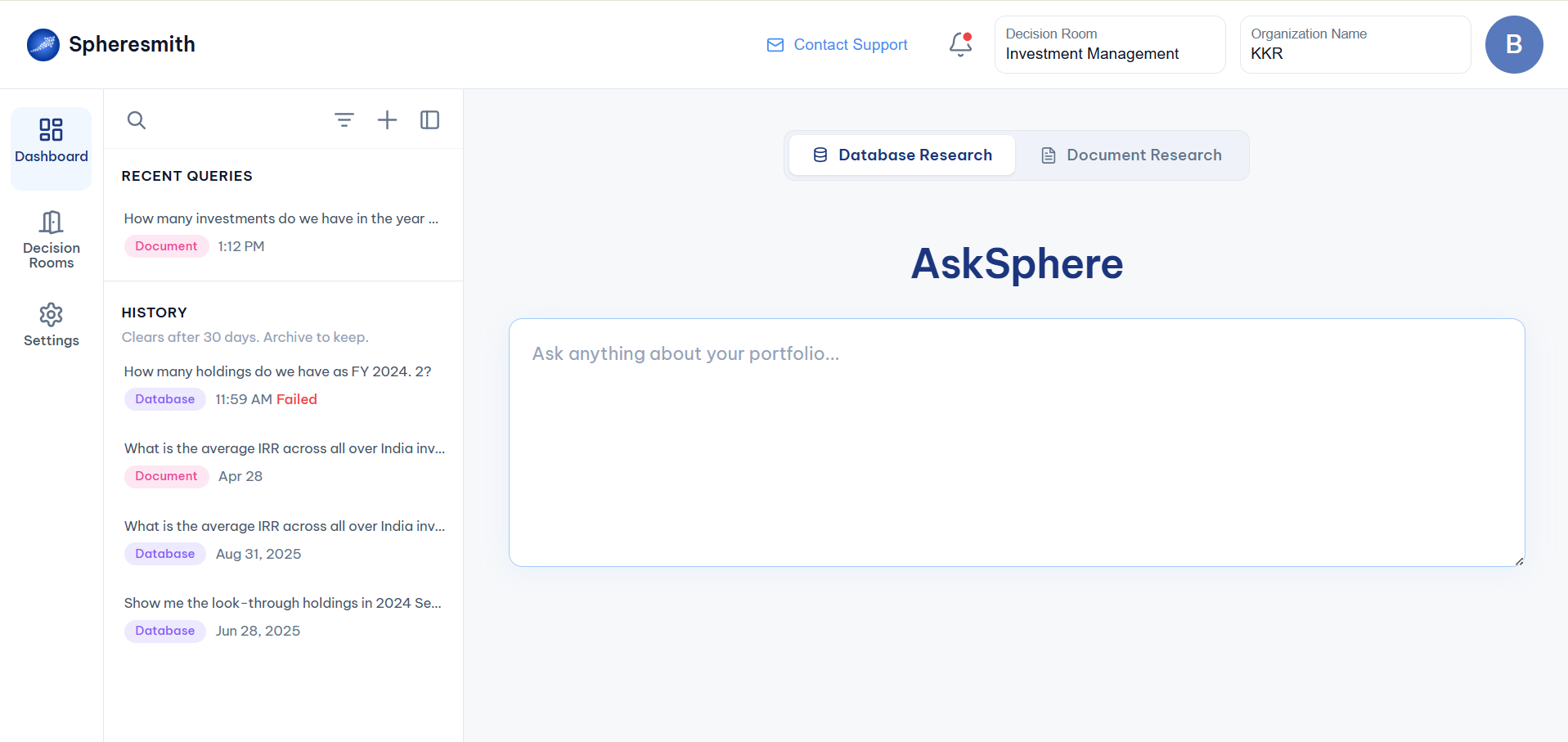
Structured questions go to Database Research (OntoTab). Unstructured questions go to Document Research (OntoRag).
History is shared
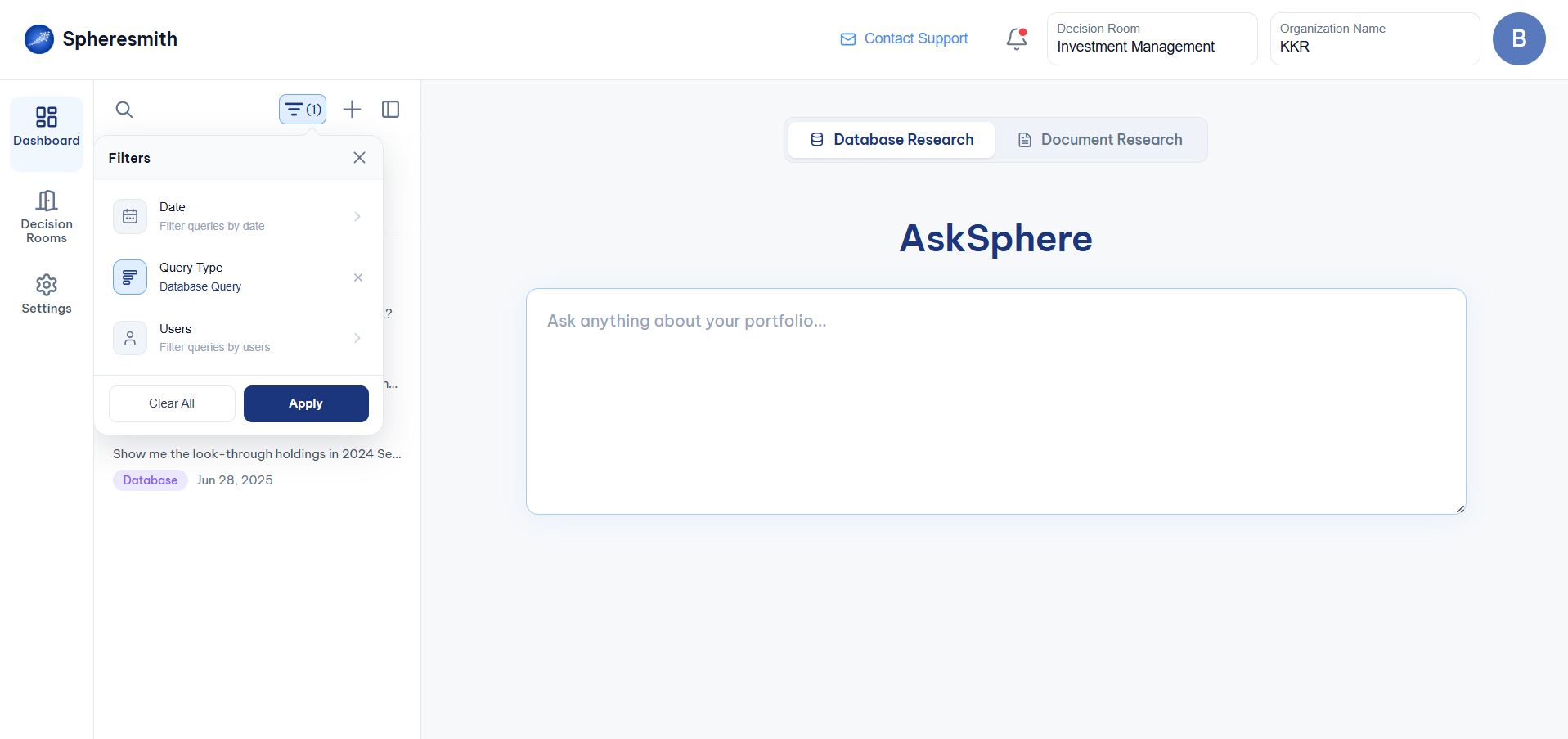
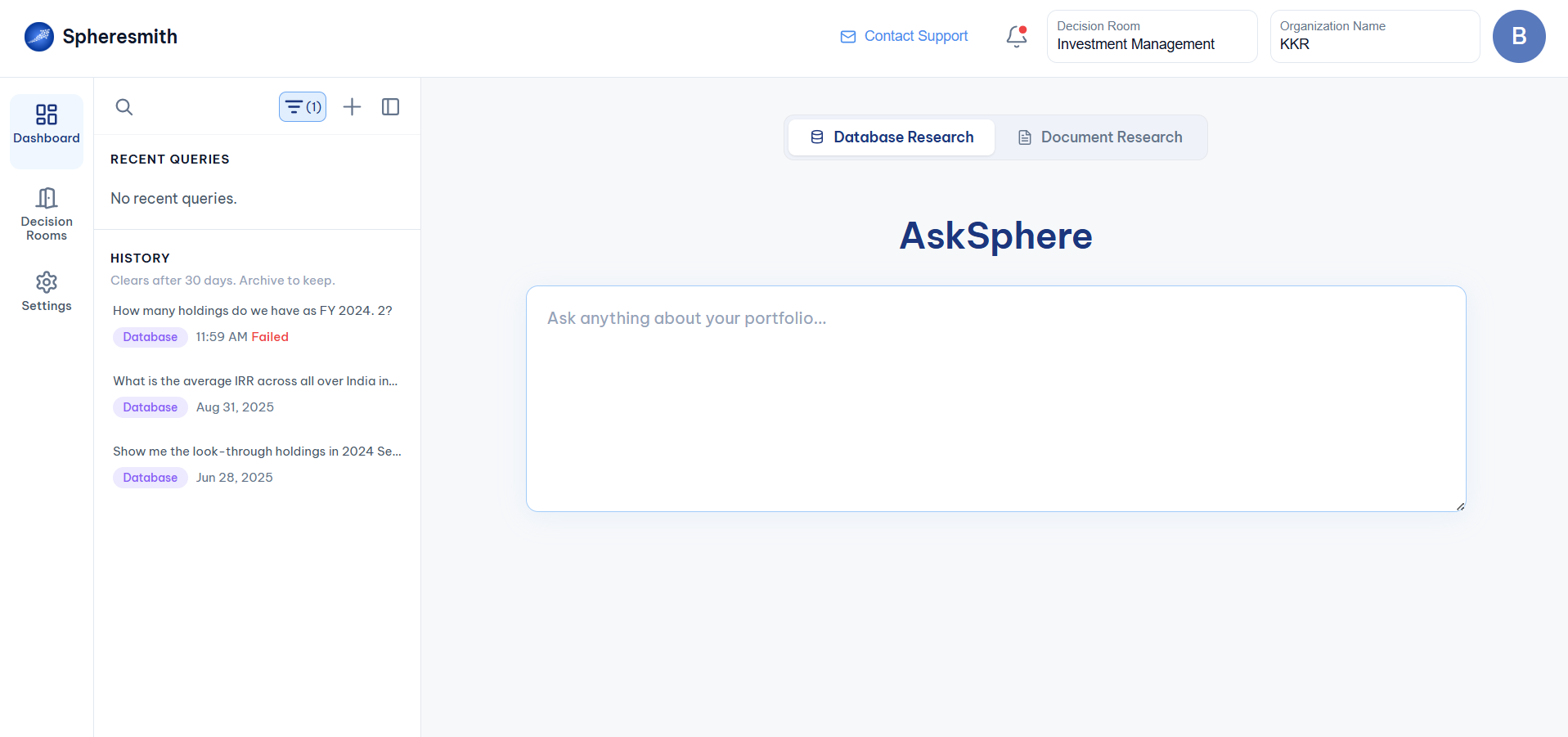
Every query is logged and tagged. It clears after 30 days unless someone archives it.
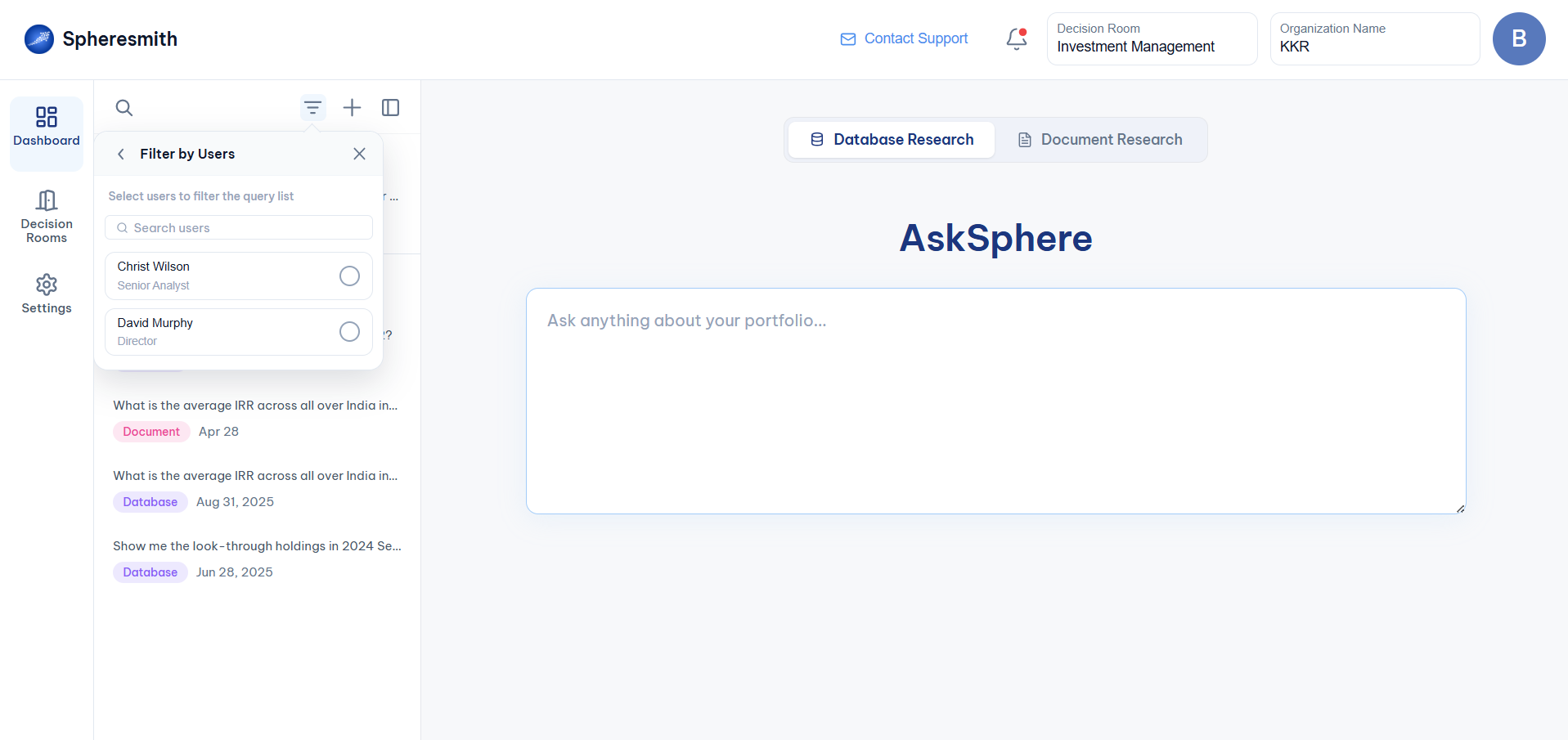
User filter is admin only
Admins can filter by user. Regular users cannot. Access follows the org chart, not a hidden button.
Disagreement is flagged
When two sources disagree on a NAV, the gap shows up before anyone has to go looking for it.
Who feels it
Who feels it most
Analysts need an answer from files they already have. Managers need a short answer they can trust. LPs need to know the number came from their data.
Financial Analyst
The answers are already in the memo. I should not paste them into ChatGPT.
Opens every day. Uploads files, asks, reviews a fund for someone else.
Needs
- Ask from internal files
- See where the number came from
- Keep the query if it will come up again
Pain
- Public LLMs cannot see the portfolio
- The same question gets asked again next week
- No source on the number
Fund manager and GP
Does this fund fit, and can I see it without a tour?
Opens when a decision is due. Wants a short answer, not a chat log.
Needs
- A number tied to a source
- History that other people can find
- A flag when sources disagree
Pain
- Waiting on email for a fact in a PDF
- Two NAVs, no one flagged the gap
- Cannot tell who asked what last quarter
Limited Partner
Is this from our files, or from the internet?
Opens less often. Checks a holding, a letter or a metric, then leaves.
Needs
- Ask once, from the portfolio
- A source they can open
- No access to queries they should not see
Pain
- Cannot see other people's queries
- A public chatbot has the wrong data
- Too many clicks for one fact
What I did
Prism search → standalone research → Cursor build
One person from the first search box to a working interface.
Start from Prism
AskSphere already lived as search in Prism for LP. The questions were bigger than a top bar.
Split two modes
A count from a table is not a clause from a PDF. Database Research and Document Research.
Shared rules
History, filters and who can see whose queries. Built for a team, not a personal chat.
Build
Designed and built in Cursor, on the design system already in Figma. Same pass. No separate mockup stage.
Two modes
Two paths, one interface
AskSphere splits every question into structured or unstructured, and answers accordingly.
Database Research
Structured queries. Tables, charts, graphs and numeric answers.
Example: "How many holdings do we have as FY2025?"
Document Research
Unstructured queries. Answers synthesized from documents and PDFs.
Example: "What does the Q3 LPA say about co-invest rights?"
Both modes are connected to our backend SoRs, so answers stay grounded in real portfolio data rather than general knowledge.
Product
What it looks like
Screens from the working build.
01 Ask anything
One entry point. Two modes to choose from.
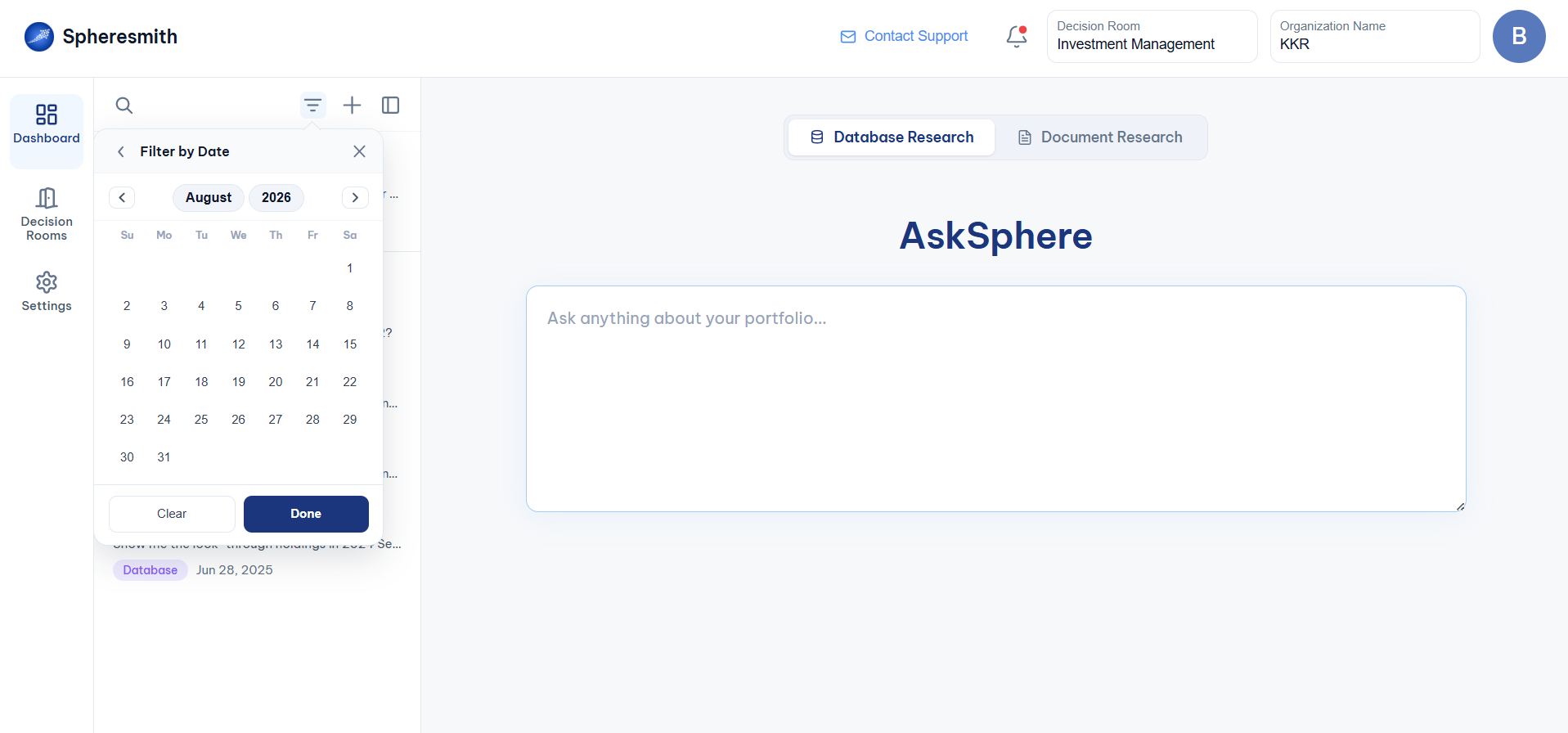
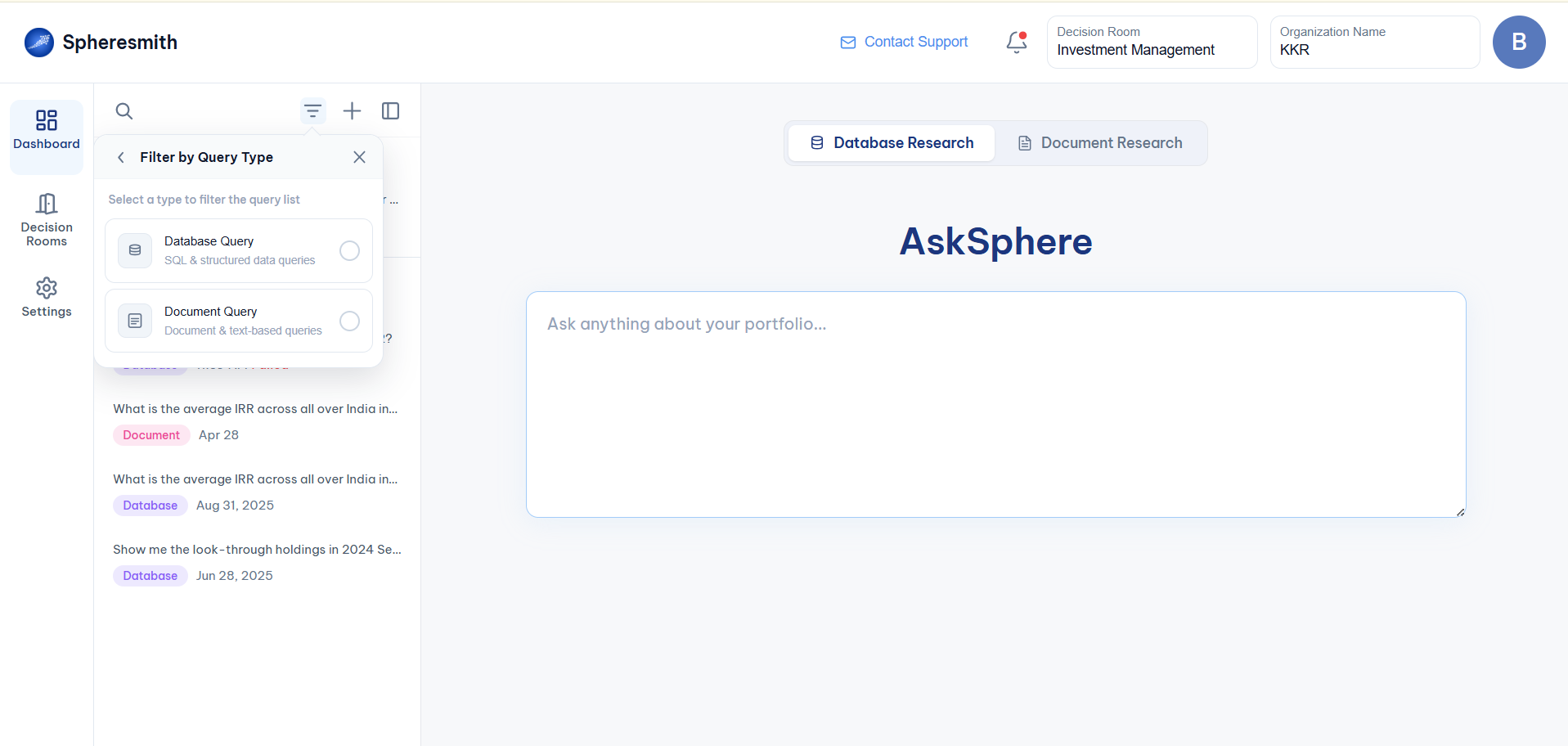
02 History you can search
Date, Query Type, Users. Users is admin only. Empty state when nothing matches.
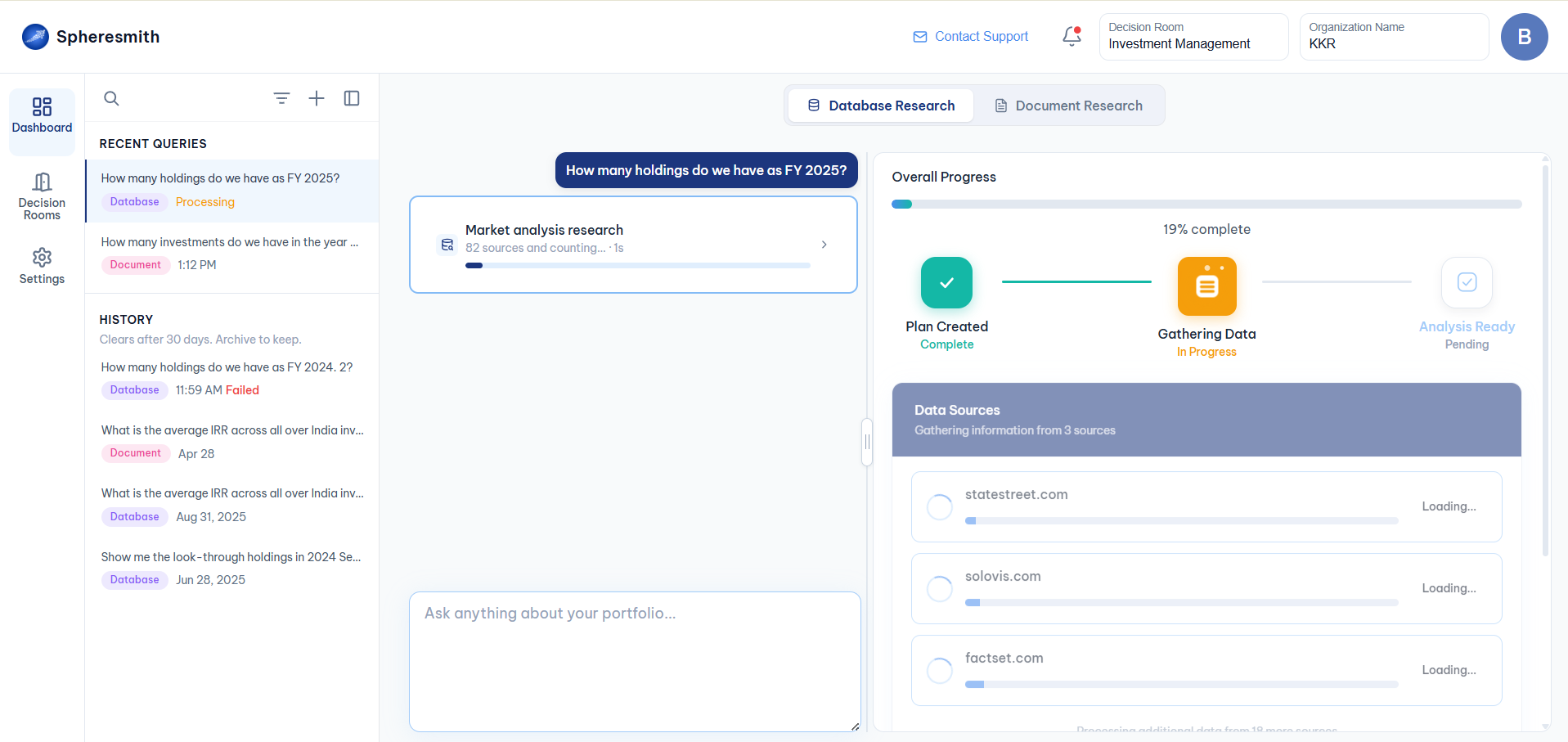
03 Sourcing is visible
Not a black box. You can see that research is running.
04 Every number tagged to its source
Summary, key metrics and the file they came from.
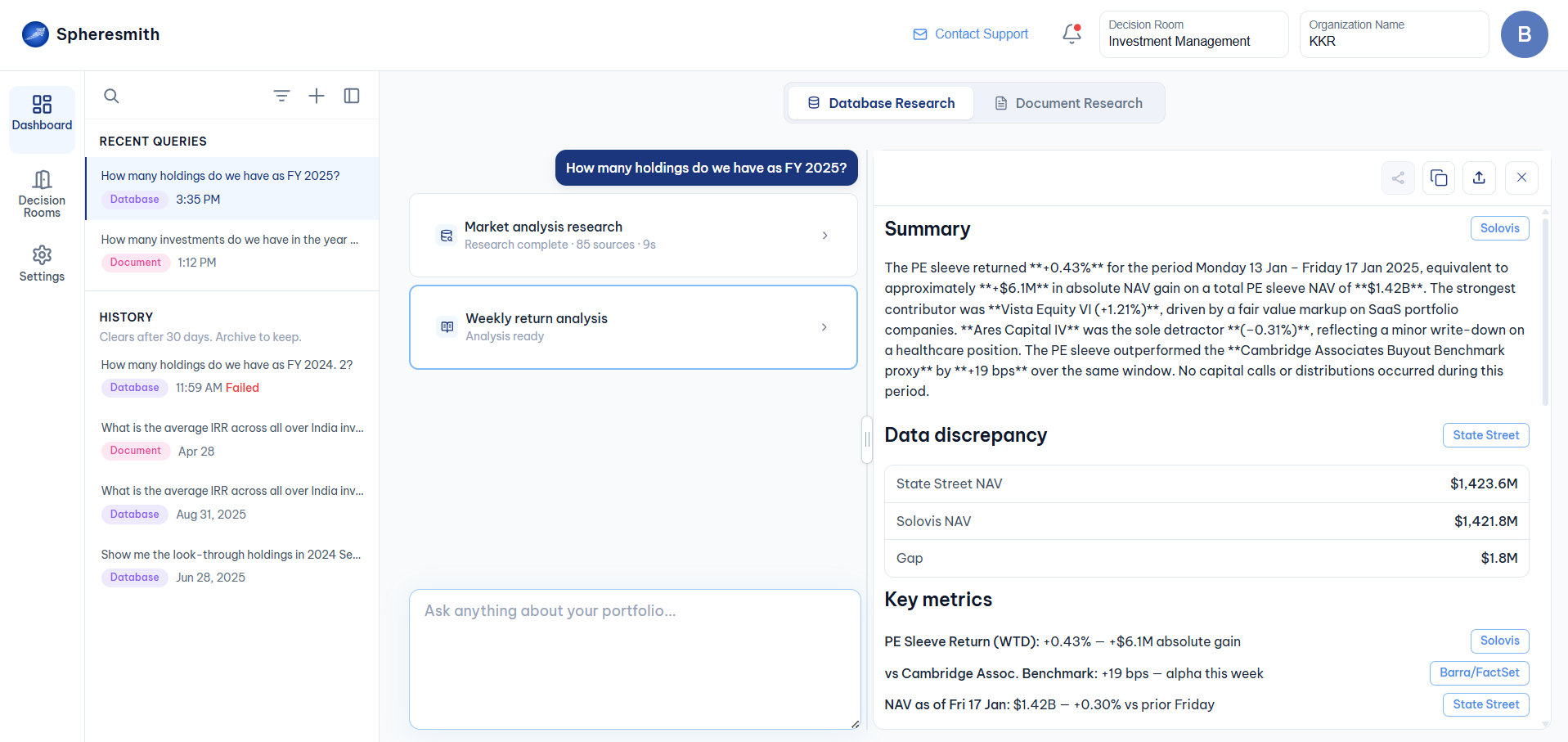
05 When two sources disagree
Analysts used to reconcile fund NAVs across sources by hand. AskSphere flags the gap before anyone has to go looking for it.
Status
Built, functional, in internal testing
Not a separate mockup pass. What you see above is the build.
On the design system already in Figma. Same pass. No mockup stage.